
Who should a permanent lighting installer mail?
Mail the houses you would be glad to quote. Permanent lighting is a custom job on the roofline, so the list matters more than the count. A good address passes four tests:
- The owner can say yes. Single-family homes, where one household decides what goes on the fascia. Skip condos and townhomes where an association controls the exterior.
- The house can carry the price. Home value is the plainest filter available, and the one we use.
- You can reach it. Stay inside the area your crew already drives. A far-off call costs a long site visit before you have quoted a foot.
- The neighborhood allows it. If you know a subdivision restricts exterior lighting, leave that ZIP code off.
Start with the ZIP codes where you have installs. Neighbors there have seen your work at night, and the card puts a name and phone number to it.
What does the card have to show?
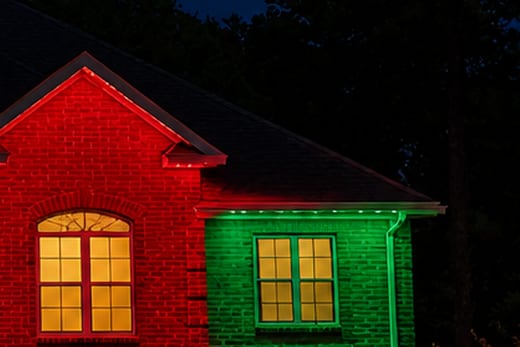
A homeowner sorts the mail on the way in from the mailbox. The front has that long to earn a second look, so it should show one thing: a house with the lights on.
A photo of a stranger's house says "this company installs lights." A picture of the homeowner's own house says "this is what yours would look like." That is why each of our cards carries a render of that address, made from a photo of that house and lit in the colors of the nearest holiday. It is an illustration, and the card should be presented as one, never as a photo of finished work.
Your Company Name
Permanent LED lighting
Call or scan
(555) 555-0142
class
Homeowner name
123 Maple Street
Your Town, ST 00000
The back has one job, which is to make the next step obvious: your company name in type large enough to read at arm's length, one phone number, one QR code that lands on a page about permanent lighting, and one request, call or scan. Leave off the rest. Track colors, app features, warranty terms and a price per foot belong in the quote, where you can explain them. A crowded card reads as a flyer.
What happens after the card lands?
Think of the card as the first touch and plan the rest yourself.
- Answer the call. Pick up the tracking line, or return a missed call the same day. A homeowner who called about lighting and reached voicemail may not call twice.
- Quote quickly. Book the visit while the card is still on the kitchen counter.
- Remember the render is an illustration. It is not a survey. You still measure the roofline and quote the real job.
- Win the street. Once you install on a block, the house does the reminding every night.
No house gets two cards from the same campaign, so nobody is nagged under your name. If you mail again, change something on purpose: new ZIP codes, or a different holiday so the colors on the render change. Then compare the two mailings on the same counts. Nobody can tell you in advance how many mailings it takes. Your first one answers whether a second is worth buying.
When should cards land against the holidays?
A homeowner who calls about Christmas colors wants the lights on before Christmas. So the question is how late a card can land and still leave you time to quote, schedule and install. Work backward from the holiday with your own numbers: your install backlog, the time you take to visit, quote and collect a deposit, and a week or two for the homeowner to act.
Then add production. The proof arrives within 3 business days, nothing prints until you approve it, and cards reach mailboxes about 2 weeks after you approve. These are estimates, not a delivery date for any single card.
As a made-up example: if you are booked three weeks out and take a week to quote, and you allow two weeks for the homeowner, cards need to be in mailboxes six weeks before the holiday. Ordering about three weeks before that puts your order nine weeks ahead. Swap in your own backlog and the date moves. The marketing guide puts this on a full-year calendar.
How do you count calls and scans?
Give the mailing its own phone number and its own QR link, used nowhere else. Every call to that number and every scan of that code then came from a card. Each of our campaigns gets both, and we report the counts to you. A scan sends the visitor to your website.
Calls and scans are the top of the count. Keep a log for each campaign: calls and scans from the tracking report, quotes given, jobs sold with the price, and anyone who says "I got your postcard" on your main line or web form. Some people look your name up instead of scanning, so ask every new caller how they heard of you.
Do not add calls and scans together and call the total households, because the same homeowner may scan on Monday and call on Thursday. And do not close the count after a week. A card can sit on a counter until the homeowner is ready. Then do the division: the cost per lead guide has a calculator where you type your own counts.
What mistakes waste a mailing?
- Mailing too late. A Christmas card that lands when you are already booked through December sells nothing this year.
- Mailing homes you cannot serve. Wrong distance, wrong home type or a neighborhood that restricts exterior lighting.
- Using your main number. Without a dedicated number and QR link you cannot tell a postcard call from any other call.
- Letting the phone ring out. The card did its work the moment the homeowner dialed. A missed call is a paid response thrown away.
- Sending scans to a page that does not match. If the QR code lands on a home page about six services, the homeowner has to hunt. Send them to permanent lighting with a phone number at the top, and check it on a phone.
- Approving the proof without reading it. Dial the phone number on the proof. Check the spelling of your company name. A wrong digit goes to every mailbox on the list.
- Judging by calls alone. Ten calls and no jobs is worse than three calls and two jobs. Count through to the sale.
- Ignoring who else is calling. A homeowner who calls you can still get a second quote. Exclusive leads explains what is and is not yours.
Questions installers ask
What does a permanent lighting postcard cost?
Ours is $1 a card on your first order, $3 after that. The $1 price covers your first order, up to 1,000 cards. Cards after that are $3 each. Render, print, postage and tracking are included. The smallest order is 250 postcards. On a first order that is $250.
Will postcards bring me calls?
Nobody can promise that, and we do not. A card puts your name and a picture of the lit house in front of a homeowner whose house is in the price range you target. What comes back depends on your area, your timing and how you answer the phone. We count the calls and scans so you can judge the mailing on your own numbers.
Can I pick the exact houses that get a card?
You pick the ZIP codes, one ZIP code for every 500 cards. Inside them, cards go to single-family homes valued over $600,000, one card per house.
Do I need a logo or a design?
No. We lay the card out for your company and send you a proof. You can add your logo after you order. Without one, your company name is set in type.
What if a homeowner does not want the card?
They can ask us to remove their address and their house image, and we will.